The Jersey Shore’s Future: From Floating Casinos to Elevated Beaches
Daniel Brouse¹ and Sidd Mukherjee²
June 2026
¹Independent Climate Researcher, Economist
²Physicist
I saw an interesting climate story about the future of the Jersey Shore and the growing challenges posed by sea-level rise, coastal erosion, and increasingly frequent flooding events.
One of my earliest climate-related case studies dates back to the 1990s and involved the Atlantic City casino industry. At the time, I was examining how major businesses were investing in vulnerable shoreline real estate and whether those investments adequately accounted for long-term climate risks.
Some of the ideas being discussed then were remarkably ambitious. Among them were concepts involving casinos built on stilts or even floating platforms, with visitors ferried back and forth from the mainland. From both a climate science perspective and an economic perspective, I viewed these proposals as problematic. As I was developing one of my first climate-adjusted real estate valuation models, it became increasingly clear that rising seas, stronger coastal storms, and accelerating erosion would create risks that could not be solved simply by elevating structures.
More than three decades later, a recent news story suggests that elements of that future are already emerging.
Elevated Adaptation on a Disappearing Shoreline
The story focuses on Showboat Resort owner Bart Blatstein and his plans to build an elevated beach club on Atlantic City’s historic Garden Pier. The project is intended to provide visitors with a beach experience while avoiding a growing problem that has become increasingly difficult to ignore: the beach itself is disappearing.
The northern section of Atlantic City’s shoreline has experienced severe and persistent erosion. Winter storms, stronger wave action, rising sea levels, and long-term coastal change have repeatedly stripped away sand, leaving sections of the beach narrower and less usable than in previous decades. In some areas, finding enough dry sand to comfortably support traditional beach recreation has become increasingly difficult.
Rather than attempting to restore the traditional beach environment at ground level, the elevated beach club effectively bypasses the problem. Built above the shoreline on the 113-year-old Garden Pier, the facility allows visitors to experience coastal amenities without direct dependence on a stable sand base that is increasingly unreliable.
From a business standpoint, the project represents an adaptive innovation. From a climate perspective, it may also reflect something broader: the early stages of structural redesign in coastal economies that are adjusting to long-term shoreline instability.
Atmospheric Rivers, Storm Surge, and Accelerated Erosion
Coastal adaptation pressures are not occurring in isolation. Extreme precipitation and storm systems are increasingly amplifying shoreline loss.
A documented example from Ocean City, New Jersey, shows how atmospheric rivers combined with storm surge can dramatically accelerate coastal erosion events. When intense moisture-laden systems intersect with high tides and coastal storm conditions, wave energy and flooding impacts compound, leading to rapid beach loss and infrastructure stress.
Atmospheric Rivers and Coastal Erosion
It is important to note that these impacts vary depending on local geography, land use, and coastal defenses. However, the underlying pattern is consistent: increasing atmospheric moisture and storm intensity are contributing to more extreme coastal erosion episodes.
Nuisance Flooding and Chronic Coastal Inundation
Long-term sea-level rise is also reshaping coastal risk profiles in less dramatic but more persistent ways.
According to NOAA analyses, “nuisance flooding” — defined as minor but disruptive flooding events that overwhelm infrastructure, close roads, and damage property — has increased by approximately 300% to 925% along U.S. coastlines since the 1960s.
As documented in Atlantic City, New Jersey, nuisance flooding has increased dramatically, with a reported 682% surge since the mid-20th century. These events are no longer limited to major storms. Instead, they now occur during high tides and moderate weather conditions due to rising baseline sea levels and reduced natural buffering systems.
As NOAA oceanographer William Sweet has noted, rising sea levels increase the baseline height of tides and storm surge, meaning that flooding now occurs more frequently even in the absence of extreme weather. These incremental events gradually erode infrastructure resilience and accumulate long-term economic costs.
A Shifting Coastal Economy
Taken together, these trends show that the Jersey Shore is transitioning from a stable recreational coastline into a dynamically changing system where erosion, flooding, and storm impacts are increasingly central to economic planning.
Historically, beaches have been among the most valuable economic assets along the Jersey Shore. Hotels, casinos, restaurants, and boardwalk infrastructure all depend on predictable coastal geography. As that stability declines, communities are forced into continuous cycles of adaptation: replenishing sand, elevating structures, redesigning infrastructure, and relocating assets.
Each adaptation reduces vulnerability temporarily but does not address the underlying driver: a changing coastal baseline shaped by rising seas and intensifying storm systems.
Conclusion: Adaptation Under Constraint
The Garden Pier project may ultimately succeed as a tourism and economic attraction. However, it also serves as a visible marker of a broader transition already underway along vulnerable coastlines.
The central lesson is not that adaptation is failing, but that it is becoming increasingly costly and structurally necessary. Coastal economies are being forced to redesign themselves around environmental conditions that are no longer stable.
Moral of the story: adaptation is increasingly becoming a cost of doing business along vulnerable coastlines, but it does not resolve the underlying drivers of change. As climate impacts accelerate, the cost and complexity of adaptation increase. Mitigation remains the only long-term strategy capable of stabilizing the system.
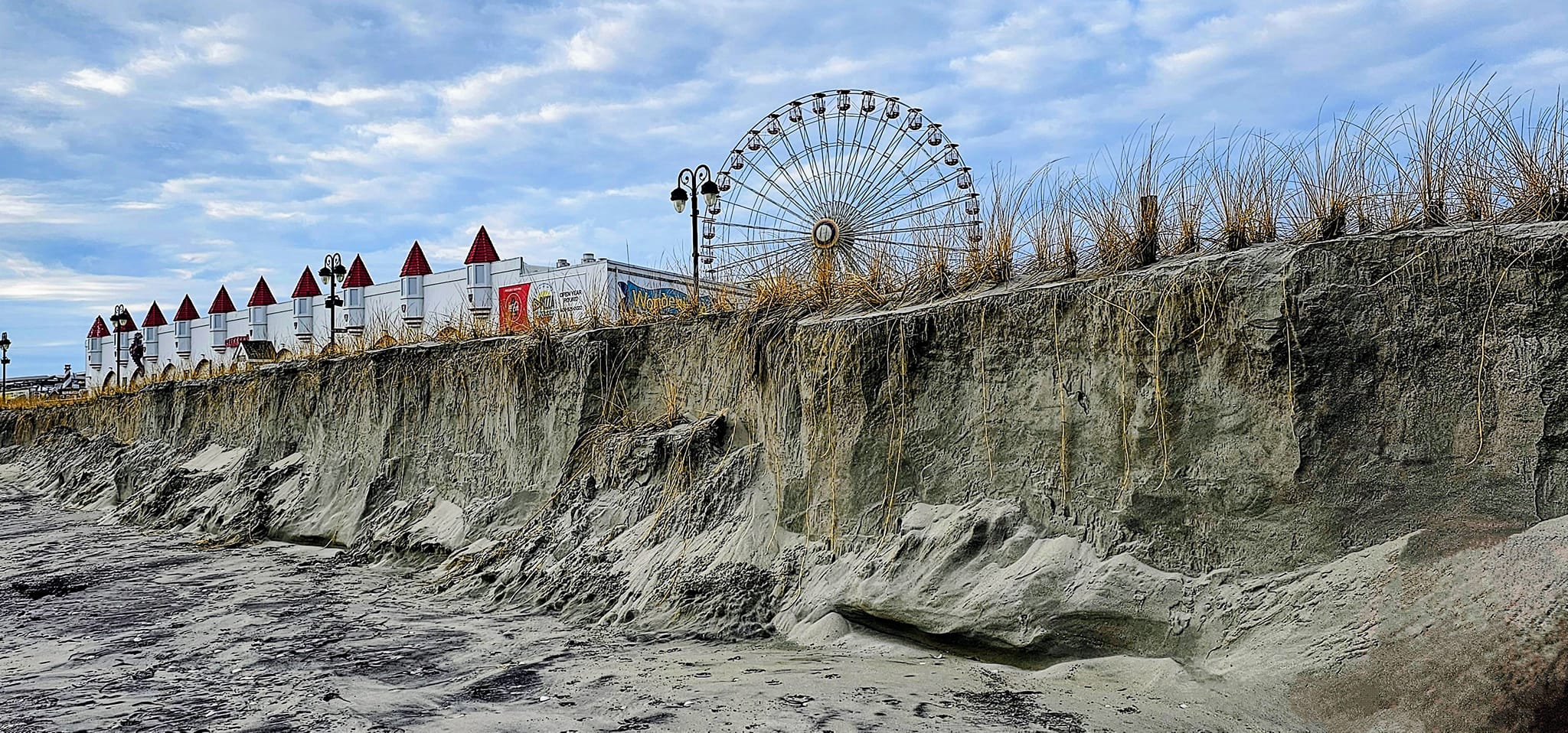
What used to be a rare Northeast atmospheric river is now becoming commonplace, contributing to accelerated coastal erosion and shoreline loss.